The SAR 120 You’re Losing Every Year Without Knowing It
Before you continue reading, take a look around your living room.
Is your TV turned off?
Good.
Now check whether the small red light is still glowing.
If it is, your TV is still using electricity.
The same thing is happening with your air conditioner, microwave, washing machine, gaming console, set-top box, and many other appliances throughout your home.
Most people in Riyadh focus on the electricity consumed when an appliance is running. Very few realize that many appliances continue drawing power even when they appear to be switched off.
This hidden consumption is known as standby power, phantom load, or vampire energy.
While a single device may only waste a few watts, the combined effect across an entire household can easily cost Saudi families more than SAR 100 every year.
When you combine this hidden energy loss with the difference between buying 5-Star vs 3-Star appliances in Riyadh, the financial impact on your annual electricity bill can become surprisingly significant.
The question is simple:
Does paying extra for a 5-Star appliance actually save money, or is a cheaper 3-Star appliance the better choice?
Let’s find out with real calculations.
Why Energy Efficiency Matters More in Riyadh
Riyadh experiences long, extremely hot summers where temperatures regularly exceed 40°C.
For many households, air conditioners operate for 8–12 hours daily during the hottest months. Refrigerators work harder to maintain cooling, and electricity consumption rises significantly.
Because cooling appliances account for a large share of residential electricity use, choosing energy-efficient appliances can have a noticeable impact on annual electricity costs.
A small difference in energy efficiency may not seem important when you’re standing in a showroom. However, over five or ten years, that difference can translate into hundreds or even thousands of Saudi Riyals in savings.
What Is Standby Power?
Imagine leaving your car engine running while it is parked outside your house.
You are not driving anywhere, yet fuel is still being consumed.
Standby power works the same way.
Even when appliances appear to be switched off, internal circuits remain active. These circuits may:
- Wait for remote-control signals
- Keep clocks running
- Store settings and preferences
- Maintain Wi-Fi connections
- Monitor internal systems
Manufacturers include these features for convenience, but the result is a small amount of continuous electricity consumption.
Individually, the cost is small.
Collectively, it adds up.
Understanding 3-Star vs 5-Star Appliances
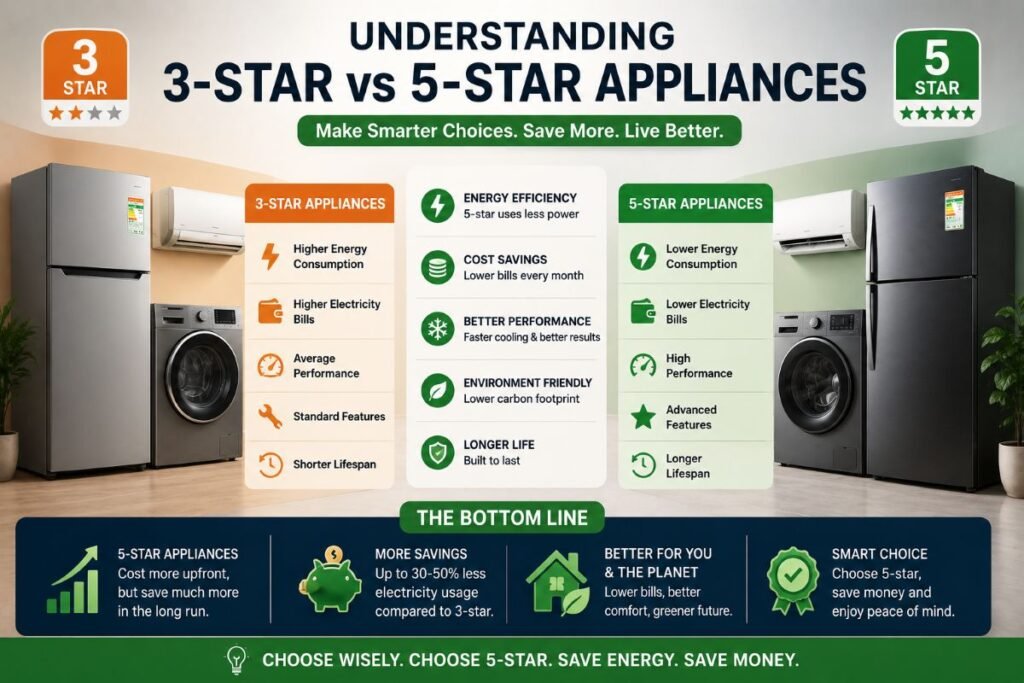
Energy ratings help consumers compare efficiency.
In simple terms:
3-Star Appliances
- Moderate energy efficiency
- Lower purchase price
- Higher electricity consumption
- Higher long-term operating costs
5-Star Appliances
- Maximum energy efficiency
- Higher purchase price
- Lower electricity consumption
- Lower long-term operating costs
Think of it like buying a vehicle.
A fuel-efficient vehicle may cost more upfront but saves money every time you fill the tank.
A 5-Star appliance works the same way.
Real Calculation: 3-Star vs 5-Star Air Conditioner
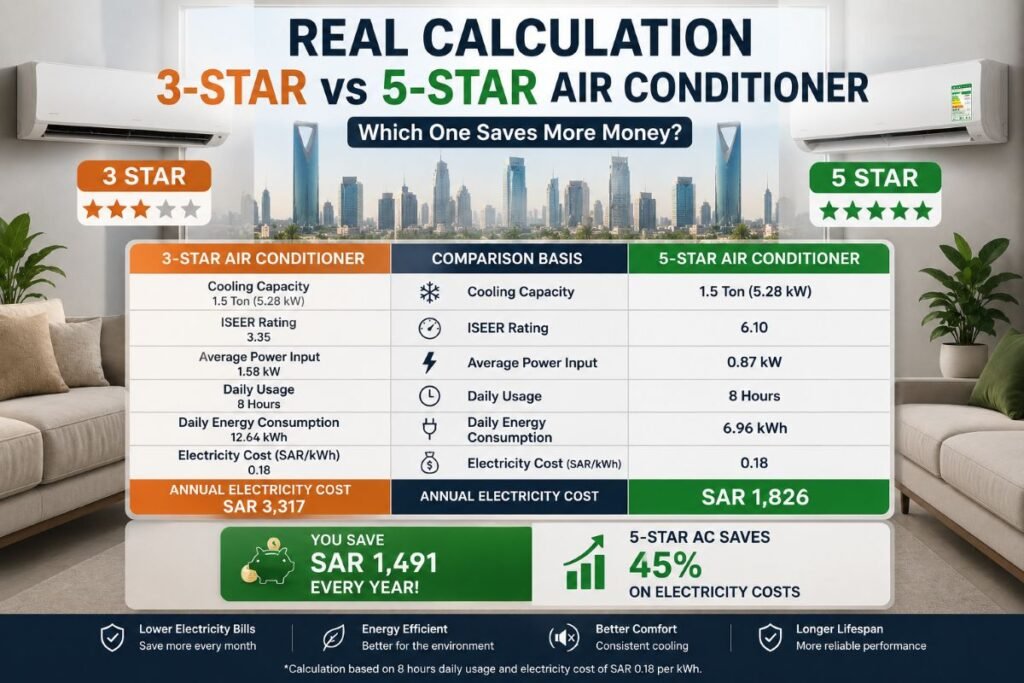
Air conditioners are often the biggest electricity consumers in Riyadh homes.
Let’s compare two 1.5-ton AC units.
3-Star AC
Power Consumption: 1.6 kW
Usage: 8 hours per day
Electricity Rate: SAR 0.18 per kWh
Daily Consumption:
1.6 × 8 = 12.8 kWh
Monthly Consumption:
12.8 × 30 = 384 kWh
Monthly Cost:
384 × 0.18 = SAR 69.12
Annual Cost:
SAR 829.44
5-Star AC
Power Consumption: 1.2 kW
Usage: 8 hours per day
Daily Consumption:
1.2 × 8 = 9.6 kWh
Monthly Consumption:
9.6 × 30 = 288 kWh
Monthly Cost:
288 × 0.18 = SAR 51.84
Annual Cost:
SAR 622.08
Annual Savings
SAR 829.44 − SAR 622.08
= SAR 207.36 per year
10-Year Savings
= SAR 2,073.60
If the 5-Star model costs SAR 500–700 more initially, it can easily pay for itself during its lifespan.
Real Calculation: Refrigerator
Unlike air conditioners, refrigerators operate 24 hours a day throughout the year.
3-Star Refrigerator
Annual Consumption:
500 kWh
Annual Cost:
500 × 0.18
= SAR 90
5-Star Refrigerator
Annual Consumption:
350 kWh
Annual Cost:
350 × 0.18
= SAR 63
Annual Savings
SAR 27
10-Year Savings
SAR 270
While the savings are smaller than an AC, they are still meaningful because refrigerators never stop running.
The 7 Biggest Energy Wasters in Riyadh Homes
Many households unknowingly waste electricity through standby consumption.
| Appliance | Typical Standby Usage | Estimated Annual Cost |
|---|---|---|
| Air Conditioner | 3–10 W | SAR 5–16 |
| Smart TV | 2–5 W | SAR 3–8 |
| Set-Top Box | 8–15 W | SAR 13–24 |
| Microwave | 2–5 W | SAR 3–8 |
| Chargers | 1–3 W | SAR 2–5 |
| Washing Machine | 2–4 W | SAR 3–6 |
| Water Heater Controls | 3–8 W | SAR 5–13 |
One device may not seem significant.
Ten devices running continuously tell a different story.
Real Home Experiment: Measuring Phantom Load for 30 Days
To understand how much electricity was being wasted, I tracked standby power consumption across several common household devices.
The results were surprising.
Smart TV
Expected: Almost zero
Actual: Around 4 watts continuously
Satellite Receiver
Expected: Minimal
Actual: Around 12 watts continuously
Microwave
Expected: Negligible
Actual: Around 3 watts for the clock display
Wi-Fi Router
Expected: Necessary consumption
Actual: Around 10–15 watts continuously
Gaming Console
Expected: Off means off
Actual: Continued background updates and standby activity
Phone Chargers
Expected: Zero consumption
Actual: Small but measurable power draw
Smart Speaker
Expected: Minimal
Actual: Constant electricity consumption due to voice monitoring and internet connectivity
Total Phantom Load
Combined standby consumption:
Approximately 40 watts
Monthly Consumption:
40 × 24 × 30 ÷ 1000
= 28.8 kWh
Monthly Cost:
28.8 × 0.18
= SAR 5.18
Annual Cost:
SAR 62.20
This is electricity being consumed without providing any useful benefit.
The Smart Plug Trick That Eliminates Phantom Load
One of the simplest solutions is using smart plugs with energy monitoring.
These devices allow you to:
- Track electricity usage
- Schedule automatic shutdowns
- Turn appliances off remotely
- Identify energy-hungry devices
For example, you can automatically disconnect:
- TV
- Gaming console
- Sound system
- Set-top box
- Microwave
during sleeping hours.
The savings happen automatically without changing your daily routine.
When Is a 5-Star Appliance Worth Buying?
Buy a 5-Star Appliance If:
The appliance runs:
- Every day
- For many hours
- Throughout the year
Examples include:
- Air conditioners
- Refrigerators
- Freezers
- Water coolers
These appliances offer the fastest return on investment.
A 3-Star Appliance May Be Fine If:
The appliance is only used occasionally.
Examples include:
- Blenders
- Vacuum cleaners
- Irons
- Food processors
These devices generally do not run long enough to justify a large price difference.
The Break-Even Formula
Use this formula before making a purchase:
Break-Even Period = Price Difference ÷ Annual Savings
Example:
5-Star AC costs SAR 600 more.
Annual Savings = SAR 207
600 ÷ 207
= 2.9 years
If the appliance lasts 10 years, the remaining years represent pure savings.
Additional Benefits of 5-Star Appliances

Many homeowners focus only on electricity savings.
However, efficient appliances often provide additional benefits:
Better Technology
Higher-rated models frequently include newer engineering and improved components.
Lower Heat Generation
Efficient appliances waste less energy as heat, which is especially valuable in Riyadh’s climate.
Quieter Operation
Many premium appliances operate more quietly.
Longer Lifespan
Improved motors and compressors may contribute to better durability.
Better Resale Value
Energy-efficient appliances are increasingly attractive to buyers.
Common Mistakes to Avoid
Buying Based Only on Price
The cheapest appliance is not always the most affordable over its lifetime.
Ignoring Usage Hours
A refrigerator runs continuously.
A blender does not.
Usage matters.
Leaving Devices in Standby Mode
Small amounts of wasted electricity add up over time.
Replacing Working Appliances Too Early
If your existing appliance is relatively new, replacement may not make financial sense.
Calculate potential savings first.
Frequently Asked Questions
Do inverter ACs also consume standby power?
Yes. Most inverter air conditioners consume a small amount of electricity while waiting for commands and monitoring internal systems.
Is unplugging appliances worth it?
For multiple devices, yes. The combined savings can become noticeable over time.
Do phone chargers consume electricity when not charging?
Yes, although modern chargers usually consume very small amounts.
Which appliance provides the biggest savings when upgrading to 5-Star?
Air conditioners generally provide the largest savings because they consume significant amounts of electricity.
How long does it take for a 5-Star appliance to pay for itself?
Typically between two and five years depending on usage and price differences.
Should I replace all my appliances immediately?
No. Start with high-consumption appliances such as older air conditioners and refrigerators.
Final Verdict: 5-Star vs 3-Star Appliances in Riyadh
For most Riyadh households, a 5-Star appliance is the better long-term investment when the appliance operates daily.
The higher upfront cost is often recovered through lower electricity bills, particularly for air conditioners and refrigerators.
However, for appliances that are only used occasionally, a 3-Star model may offer better value.
The smartest approach is simple:
- Buy high-efficiency appliances where efficiency matters most.
- Eliminate standby power wherever possible.
By doing both, you can reduce your electricity expenses year after year without sacrificing comfort.
Free Home Energy Audit Checklist
Before buying your next appliance, review:
✓ Appliance wattage
✓ Daily usage hours
✓ Energy rating
✓ Annual electricity cost
✓ Expected lifespan
✓ Break-even period
✓ Standby power consumption
✓ Smart plug opportunities
✓ Seasonal usage patterns
✓ Total ownership cost
A simple home energy audit today could save you hundreds or even thousands of Saudi Riyals over the next decade.